Industrial Planning
From layout to foundation: the layout as a common denominator
 In industrial planning, it is considered the supreme discipline. This is because layout planning forms the common foundation of most planning disciplines – from building design and equipment planning to material flow planning.
The basis of layout planning is sound consideration of the dimensioning and equipment of individual functional areas. Ideally, specific parameters have already been defined together with you in advance, for example within the site strategy, the production concept, or plant structure planning.
► Minimised material flow: the objectives of layout planning
- Process-oriented structuring of all functional areas – from goods receipt to goods issue
- Demand-oriented dimensioning and balancing of space requirements for all functional areas – tailored to the production and logistics volumes defined in the quantity framework
- Minimisation of material flow effort (transport performance) between functional areas
- Integration of all structure-defining operational equipment (e.g. assembly lines, coating systems, loading docks)
► The ModularFactory: from Lego brick to modular layout
Under the name “ModularFactory”, LogistikPlan has developed an independent tool for adaptable and sustainable factory concepts over recent years. The method has been successfully tested in numerous projects – including for clients in medical technology, the chemical industry, and the automotive supply industry.
As an integrated tool, “ModularFactory” provides continuous software support in early planning phases
- from strategy definition
- through data modelling
- and layout conception
- to solution evaluation
► All layers in view: the layout planning table
Modern production and logistics systems may not be built from Lego bricks, but they are composed of standardised, modular elements that meet both industry-specific standards and company-specific requirements.
With the LogistikPlan layout planning table, we have developed a tool that has proven itself in large industrial planning projects as well as in factory projects for our medium-sized clients.
The Visio-based 2D drawing tool always provides maximum transparency – especially in complex building structures, multi-storey layouts, or expansion stages. Thanks to customer-specific component libraries, it allows existing layout solutions to be duplicated, modified, or simply rearranged with ease.
► Planning on four levels: our services
In layout planning, LogistikPlan prepares detailed plans for machine positioning (machine layout), workshop equipment (equipment layout), production logistics (material flow layout), and media supply (connection layout for machines and workstations).
■ Machine layout planning
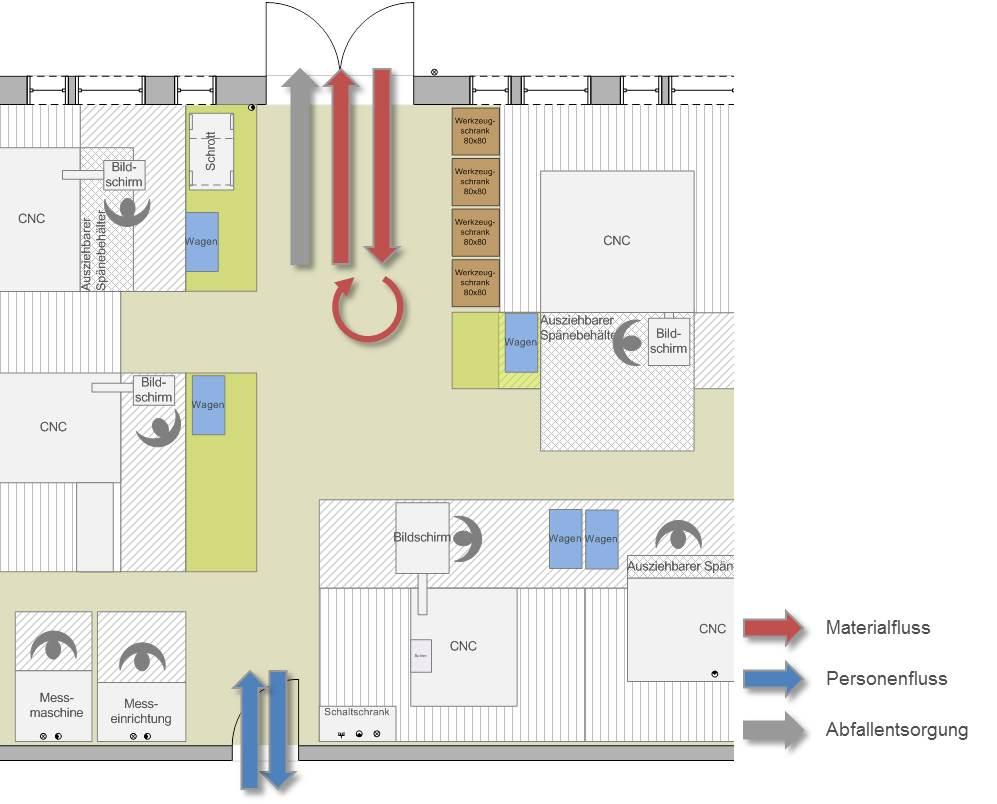
- Machines and equipment are positioned with precise dimensions according to their space requirements, material flow relationships, and other technical criteria within the given building layout. Where necessary, multiple variants are analysed to determine the optimal arrangement. The layout plan shows machine footprints, buffer areas, operating areas, transport routes, and other auxiliary spaces.
- Evaluation of the layout solution is carried out using functional and technical criteria, and, where applicable, economic criteria. The selected preferred variant is further refined depending on optimisation potential and documented for execution planning.
■ Workshop equipment planning
The equipment layout serves to position all equipment objects required directly in the production process. It is based on the detailed machine layout and may lead to fine adjustments, for example to accommodate maintenance areas, tool cabinets, or measuring equipment close to workstations (see Equipment Planning).

■ Production logistics planning
Layout planning for production logistics includes
- the preparation of the material flow layout (see Material Flow Planning) with precise definition of routing and handover points between machines and workstations
- the design of transport, loading, and buffer areas (e.g. material buffers at machine workstations, buffer areas for special functions)
- the dimensioning of area buffers and interfaces to adjacent or external logistics areas (e.g. doors, loading docks, conveyor systems, lifts)
■ Media supply planning
To ensure the provision of all utility connections at machines and workstations, the type and capacity of connections, layout principles, and interface design are specified. The positioning and dimensioning of utility connections within the equipment layout takes into account
- the requirements of production users
- the requirements of maintenance
- and the constraints of overarching MEP planning, e.g. for optimal routing or low-loss compressed air supply
► Structure & details: the planning result
- The result of layout planning is the equipment layout. Within the detailed building structure, it defines the arrangement of all fixed building and operational equipment.
Layout concept for a training workshop (LogistikPlan project example 2015)
- In addition to the precise positioning of machines and systems, the detailed layout also depicts a wide range of detailed solutions, such as
- ergonomically designed machine workstations
- assembly lines or assembly islands
- buffer zones and storage positions for Kanban containers in assembly logistics
- measuring and testing stations in quality inspection
- packaging material storage and carton erectors to supply a packaging line
- The graphical representation of all functional areas is provided as a detailed layout including material flow layout and workshop equipment, at a scale of 1:100 (e.g. as a Visio or AutoCAD drawing in DWG format).
- The space balance with target–actual comparison includes the dimensioned required areas and the planned areas shown in the detailed layout for production, logistics, and ancillary functions.