Warehouse Concepts
Not just at Christmas: warehousing makes companies happy
 Warehouse space is almost always in short supply – at the latest during the Christmas season. After all, stocking inventory is a welcome service that makes life easier for both sales and production.
Our secret recipe for warehouse managers: ensure forward-looking demand planning, compaction and process optimization on a regular basis. In addition to these warehouse hygiene measures, outsourcing of warehouse capacity can of course also help – but above all: a well-designed warehouse concept.
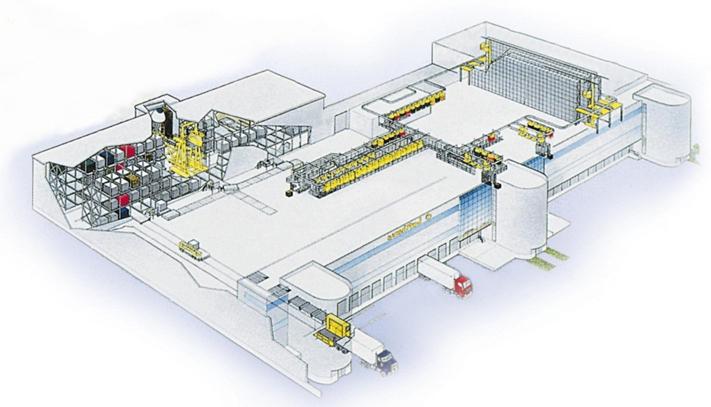 Graphic: visualization of a logistics center
► When should you start thinking seriously about warehouse modernization?
Five typical symptoms of delayed modernization or expansion:
- the utilization of your warehouse space exceeds 90% (travel paths and rack aisles are already being used as permanent pallet parking)
- order picking requires repeated handling (for inventory counts, you might need industrial climbers or drones)
- warehouse processes take far too long (try measuring the time from goods receipt to goods issue)
- secondary functions take place outdoors (empty pallets are now standing in the snow)
- an increasing number of material flows take place within the same area (the warehouse pre-zone becomes a traffic risk)
► What objectives do you set for the development of your warehouse concept?
- the warehouse structure allows step-by-step, modular growth
- logistics processes are efficient and scalable over daily or weekly cycles
- warehouse equipment is functionally appropriate and the degree of automation is economically viable
- the warehouse layout enables low-intersection and directed material flows
- space utilization is flexible and can be repurposed during ongoing operations
- industry-specific safety and quality standards are met
► Which tasks do we take on for a logistics concept?
1. Data and process analysis (see: Logistics analyses)
- Analysis of item requirements and target volumes (current-state analysis, demand forecasting, mapping within the volume model across different expansion stages)
- Analysis of warehouse processes and derivation of approaches for optimizing logistics processes
- Analysis of space utilization and building structure, clarification of restrictions related to construction, building services and fire protection
2. Variant-based concept development
- Functional concept (definition of functions, target processes)
- Warehouse equipment concept (dimensioning and selection of storage, conveying and container systems)
- Warehouse layout concept (balancing space requirements and arranging all functional areas such as goods receipt, goods issue, pallet storage, picking areas, shipping and special processes)
- Material flow concept
3. Variant evaluation and selection
- Comparison of demand and capacity (equipment, space and personnel requirements, utilization analysis)
- Calculation of upcoming investment and operating costs (± 20%)
- Utility value analysis to evaluate variants based on weighted criteria
- Decision proposal for the preferred variant
► Results of the warehouse concept:
- Warehouse demand volumes are transparent
- Target processes are defined
- Layout and equipment are well thought out
- Costs and benefits are evaluated
- (Christmas is secured)