Logistics Analyses
Figures – data – facts
Admittedly:  Not everyone is born to be an analyst. But you don’t have to be born with it to capture and evaluate complex data – after all, there are proven software tools available for almost every analytical task.
What would consulting be without analysis, what would planning be without a volume model? Almost every one of our projects begins with an analysis phase in which, for example, logistics-related base data is collected, logistics structures are analyzed and processes are examined.
The subtle difference between…
► Data collection
By data collection, we at LogistikPlan do not mean analysis, but initially “only” the transfer, preparation and completion of data bases.
For this purpose, our clients compile all professionally relevant documents, data extracts and files required as input for the project work, for example:
- production- and logistics-related actual and planned data (inventory levels, order volumes, machine utilization)
- organizational data (organization charts, job descriptions or process descriptions)
- structural and drawing data (to determine the available space capacity of a site)
► Data capture
Determining data that is not yet available usually requires the greatest effort at project start-up. Especially when it comes to process-relevant data, the factors of time and frequency are decisive for data quality. In production and logistics environments, measurement series over several days or weeks are not uncommon.
Standardized, scientifically sound measurement methods are commonly used for data capture, for example counting physical movement frequencies at a loading dock using optical sensors.
In business practice, however, we more often apply individually adapted data capture methods in order to achieve a good balance between effort and benefit. For example, the aforementioned dock utilization can also be recorded using simple tally sheets or time logs. Multi-moment studies with a large sample size – for example over 10 or 20 shifts – also provide reliable, high-quality planning data.
► Analysis
Within the scope of analyses, the available data is ultimately examined in order to derive specific insights and support decision-making. Here are a few examples from production and logistics planning:
- Analysis of existing inventory volumes (e.g. product groups, coverage ranges, batch sizes, geometry and weight classes, ABC structures…)
- Evaluation of order data (entire assortments or representative item types) to derive temporal or structural requirements of assortments
- Development of a consistent current-state volume model covering all warehouse and order volumes
- Derivation of future logistics volumes, taking into account order- or project-specific fluctuations, ABC structures and special storage functions
- Assessment of changes in product structure and their impact on future production, transport or warehouse requirements
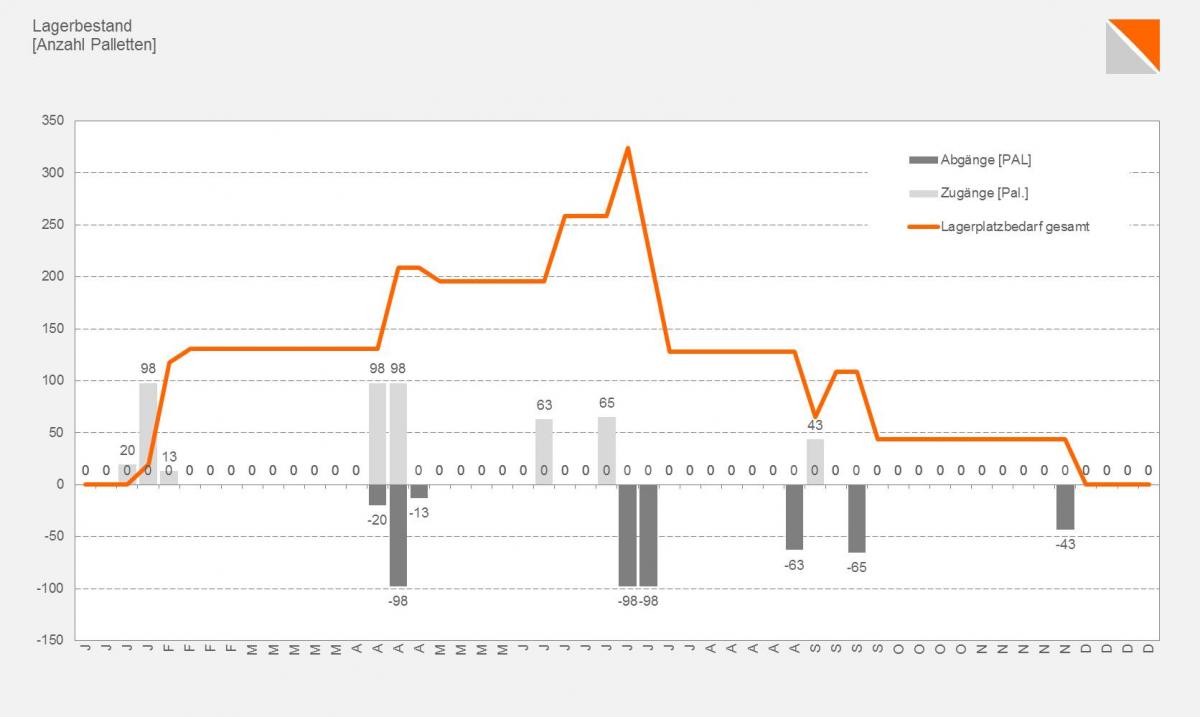
The central focus of our diagnosis is the analysis of order throughput and material flows. Our planning success depends largely on a deep understanding of processes, their organizational environment, and their technical and logistical conditions.
Put to the test: the LogistikPlan process analysis
In process analyses, we discuss the key workflows, operating rules and tools (IT systems, information documents, etc.) with representatives of the involved departments – for example in two-hour workshops.
Processes, interfaces and responsibilities are documented using process analysis and value stream design methods; current procedures and routines become visible, as do optimization points and proposals for change.
Example results of the process analysis:
- Process diagrams as a data basis for defining target production and logistics processes (functional concepts)
- Block flow diagrams as a data basis for specifications of new IT functions
- Transparency regarding quality characteristics, potentials and weaknesses to initiate upcoming optimization or restructuring
- Proposals for immediate actions
- Prioritization for further improvement measures
Too much of a good thing? For our mid-sized clients, we offer – in addition to the diagnostic services described above – a short yet intensive analysis:
The small blood test: the LogistikPlan Quick Check
Companies with limited time and/or budget can still obtain an external, independent perspective with the LogistikPlan Quick Check. With a fixed effort of five consulting days, we conduct a comprehensive potential analysis of your logistics with regard to
- capacity,
- organization,
- economic efficiency, and
- technology.
Results of the Quick Check:
- Diagnosis of your current logistics situation using a quick-check list and process analysis
- Identification of weaknesses and optimization potential
- Assessment of optimization needs and feasibility
- Explanation of optimization proposals and derivation of an action plan