Outsourcing
Are you still warehousing – or already saving?
 Transport logistics services have long been outsourced in industry. However, “true” outsourcing is not just about individual sub-functions, but about complete logistics system requirements.
The high potential of logistics outsourcing is no coincidence, as it enables a highly flexible, cost-variable response to fluctuating order volumes.
Young companies in particular appreciate this, for example in e-commerce. Many fast-growing online retailers no longer handle their assortments themselves. They outsource warehousing and shipping to specialized logistics service providers.
In addition to external contract logistics, dropshipping is also increasingly used: products are shipped directly from the manufacturer or wholesaler to the end customer – it is hard to optimize inventory and process costs more effectively.
The full program? It could look like this:
1. Preparation
- Analysis of the existing supply chain, comparison with benchmarks and best-practice solutions
- Derivation of optimization measures (organizational and technical)
- Description of the sourcing and distribution strategy
- Assessment of supply chain risks and derivation of preventive measures
- Alignment of the tender concept and bidder matrix
2. Design
- Preparation of the specifications document
- Definition of requirements for the services to be outsourced
- Definition of qualitative and quantitative objectives
- Definition of supplier relationships and delivery models (e.g. JIT, JIS, VMI …)
- Design of future material and information flows
3. Tendering
- Execution of the tendering process (single- or multi-stage)
- Evaluation of bidders and submitted offers
- Support of the client during contract award negotiations
- Preparation of the award recommendation
4. Implementation
- Consulting support in contract design
- Assistance in preparing the collaboration
- Support during commissioning and optimization of contractual services

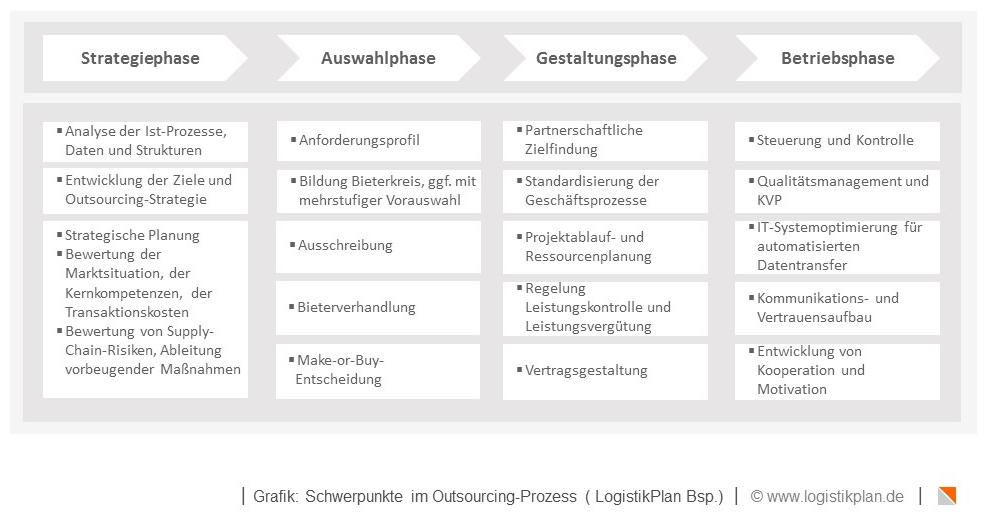 Key focus areas within the outsourcing process
Results at a glance:
- Professionalized warehousing and transport processes
- Increased flexibility of logistics capacities
- Variable logistics costs
- Improved target metrics and KPIs